Nvidia and the Trillion-Dollar AI Infrastructure Race
From Phoenix to Abu Dhabi, hyperscalers are pouring unprecedented sums into compute. The build-out is reshaping energy markets, real estate, and the geopolitics of silicon.
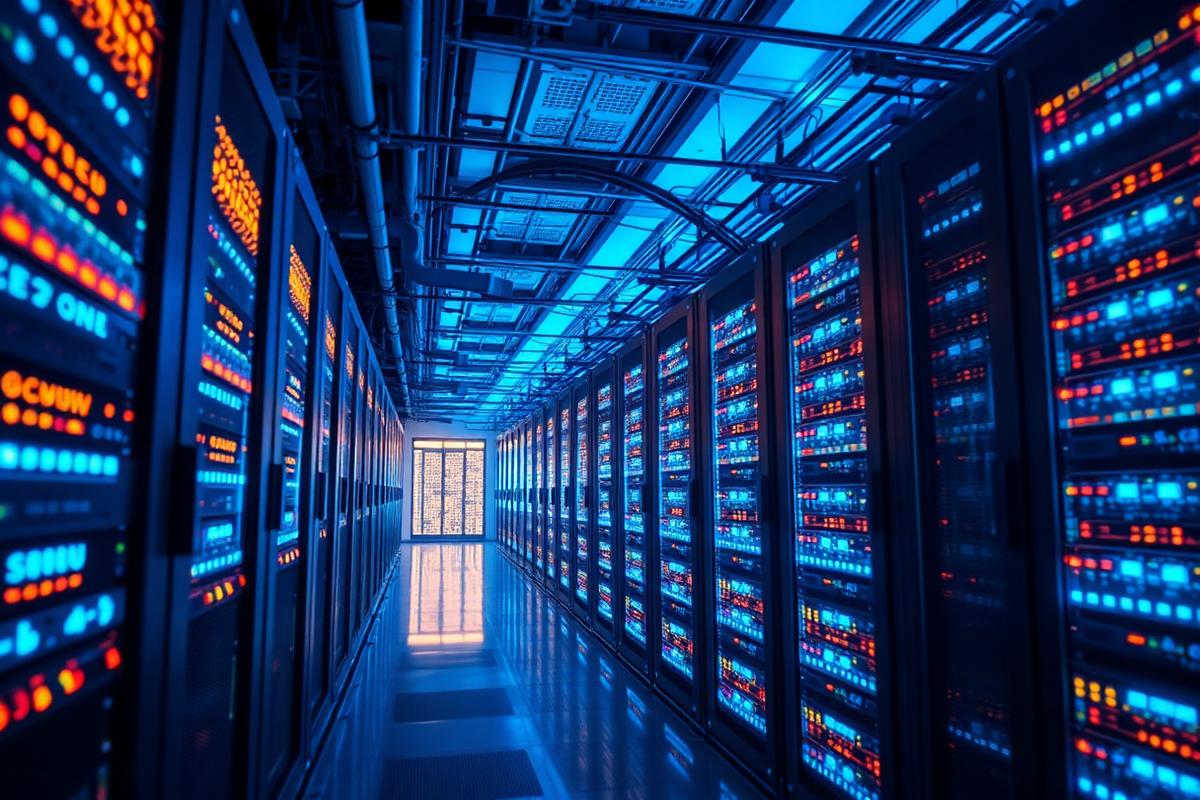
In a featureless industrial park forty miles west of Phoenix, an army of construction crews is racing to complete what will be, when finished next year, the largest single artificial-intelligence training facility ever built. The 1.2-gigawatt campus — roughly the power draw of a mid-sized American city — represents a $48 billion bet that the appetite for generative AI compute has not yet peaked.
It is one of more than two hundred such projects under way across four continents. Together they constitute the most ambitious infrastructure build-out the technology industry has ever attempted, and one of the largest capital deployments in modern economic history. Bank of America estimates total AI infrastructure spending will exceed $1.4 trillion between 2025 and 2028.
At the centre of it all sits Nvidia. The Santa Clara company's H200 and Blackwell-class GPUs remain the de facto currency of the AI economy, and chief executive Jensen Huang's quarterly earnings have become geopolitical events. Last week's report — a 78 percent year-on-year revenue increase to $52 billion — once again exceeded the most optimistic Wall Street estimates. Yet the more interesting numbers were buried in the data centre segment commentary.
Sovereign AI initiatives now account for roughly 14 percent of Nvidia's data centre revenue, up from less than 2 percent eighteen months ago. Saudi Arabia's HUMAIN, the UAE's G42, France's Mistral-aligned national compute project, and Japan's Sakura Internet have all placed multi-billion-dollar orders. "Every nation now understands that AI is the next form of industrial infrastructure," Huang told analysts. "You cannot outsource it."
The implications cascade in unexpected directions. Electricity demand from U.S. data centres is projected to triple by 2030, forcing utilities to revisit decommissioning schedules for natural-gas plants and accelerating investment in small modular nuclear reactors. Hyperscalers are now among the largest direct purchasers of nuclear power, with deals announced in the past year by Microsoft, Amazon, Google, and Meta.
Real-estate markets near fibre and power corridors are being remade. Industrial land values in northern Virginia, central Texas, and the Riyadh-Qassim corridor have doubled in twenty-four months. Specialist data-centre REITs have been among the best-performing securities of the cycle.
Skeptics — and they exist — note that monetisation of generative AI applications still trails the pace of infrastructure spending. OpenAI is reportedly losing money on every Pro subscription. Enterprise pilots frequently fail to scale. The history of technology is littered with infrastructure cycles whose returns disappointed even when the underlying thesis proved correct.
But the build-out itself is now a self-reinforcing economic force. Whatever the eventual return on capital, the world is being wired for an AI-native future at a pace that would have seemed impossible three years ago.
More from Technology

OpenAI's $300 Billion Valuation Marks AI Capital Cycle Peak
The latest tender offer crystallises a valuation expansion that has outpaced even the company's accelerating revenue trajectory.
Anthropic's Claude Opus 4 Sets New Benchmark on Reasoning Tasks
The latest model from the San Francisco lab posts state-of-the-art results on advanced reasoning evaluations, intensifying competitive pressure on OpenAI and Google.
AWS Reports Strongest Growth in Two Years as AI Workloads Scale
Amazon's cloud unit posts $33 billion in quarterly revenue, with operating margin expanding to 39 percent.